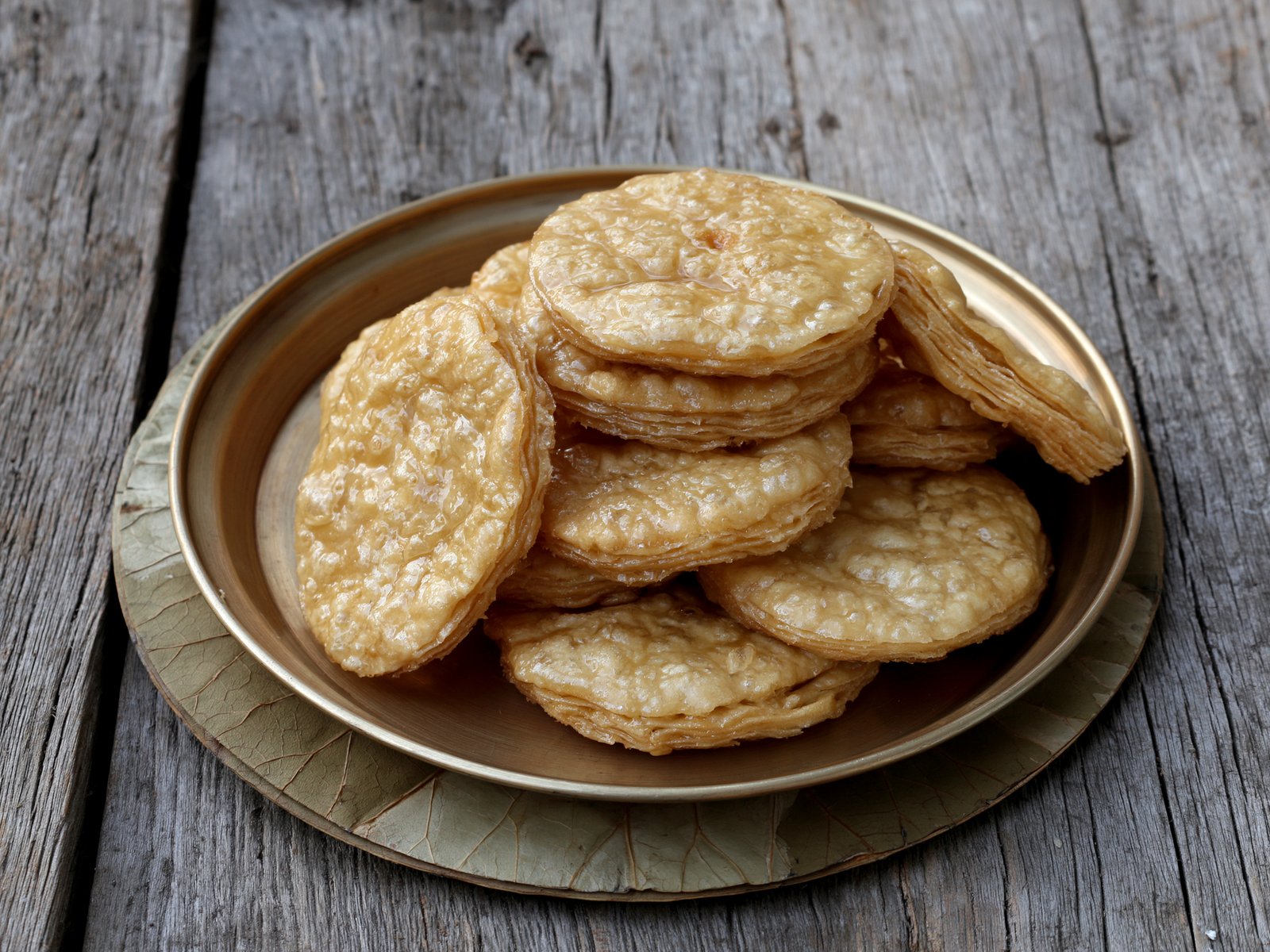
Silao is a town on the road between Rajgir and Nalanda and it does one thing, in shops that line the main road. Khaja is built rather than mixed: a dozen to sixteen sheets of dough are rolled paper-thin, smeared with a paste of ghee and flour, stacked one on the next, rolled into a log, cut across, and flattened so the layers run through the cut face. Fried, they separate and lift into something closer to pastry than to mithai, then go into syrup, which soaks the outer layers and leaves the inner ones dry. It carries a GI tag for that construction. And it has a job in the region beyond eating: khaja is what a family sends with a daughter at her bidai, packed in boxes when she leaves for her husband’s house, because it is sweet, it looks like effort, and it survives the journey.
INGREDIENTS
- 400 g plain flour
- 4 tbsp ghee (for the dough)
- ¼ tsp salt
- water (to knead)
- 6 tbsp ghee (for the layering paste)
- 4 tbsp plain flour (for the layering paste)
- ghee or neutral oil (for deep frying)
- 400 g sugar
- 200 ml water (for the syrup)
- 4 green cardamom pods (crushed)
- a few strands of saffron
METHOD
- Rub the 4 tbsp ghee and the salt into the 400g flour, then knead with water into a firm, smooth dough. Cover and rest for 30 minutes.
- Beat the 6 tbsp ghee with the 4 tbsp flour into a smooth thick paste. This is the layering paste and it is what forces the sheets apart.
- Divide the dough into four. Roll each piece as thin as you can into a large sheet.
- Smear the first sheet all over with the paste, lay the second on top, smear again, and continue until all four are stacked.
- Roll the stack up tightly into a log, keeping it firm. Rest it 15 minutes.
- Cut the log into discs about 2cm thick. You will see the layers in the cut face.
- Lay each disc cut-face up and roll it gently into an oval about 1cm thick. Do not press hard or you will crush the layers shut.
- Heat ghee or oil to a low temperature — a piece of dough should rise slowly, not sizzle.
- Fry a few at a time for 8 to 10 minutes, turning, until the layers have visibly separated and lifted and the khaja is pale gold. Raise the heat slightly at the end to crisp them.
- Meanwhile boil the sugar and water with the cardamom and saffron for 5 minutes to a thin syrup.
- Dip each hot khaja into the warm syrup for 20 seconds only, then lift onto a rack.
- Cool completely. The outside will be sticky and the inner layers dry and crisp.