The Letter · Issue One
Three kitchens, two centuries of movement, and one word they all use.
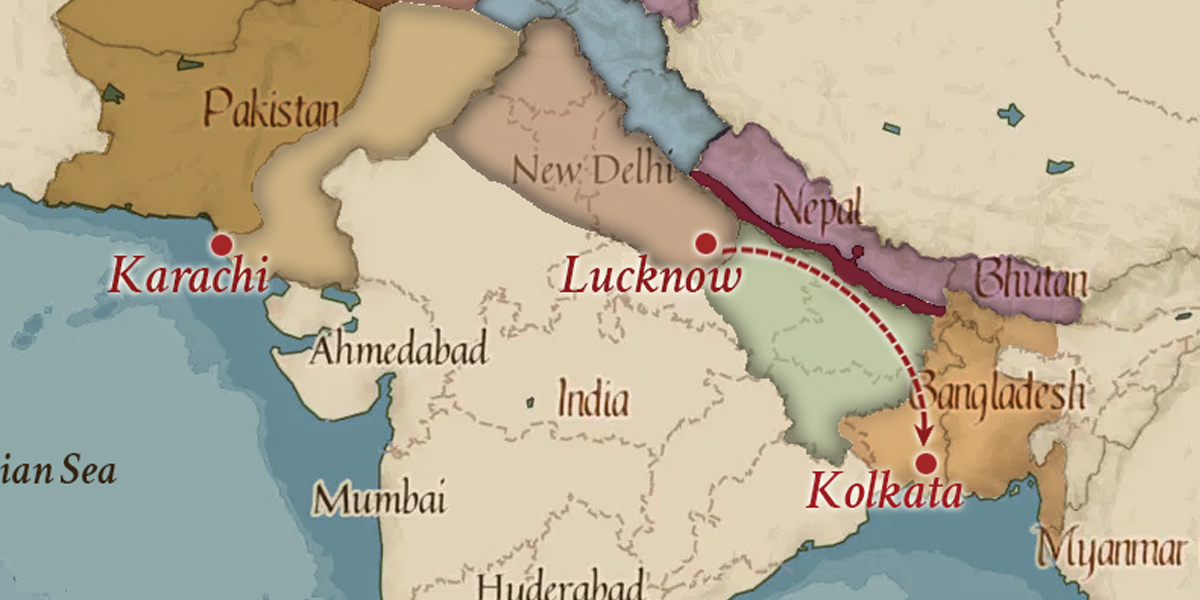
Found & Feasted is a culinary atlas. We map the world by what people cook — by pantry, technique and trade route — rather than by the borders drawn over the top of them. A flavour region crosses a national line wherever the cooking does, because the cooking got there first.
Three regions are drawn so far: the Indus Plains, the Mughal Corridor, and the River Delta. This letter goes out when there is something worth saying. Today there is one word worth the width of the subcontinent.
A note, once
Most of the world’s food reaches English in translation, and something is lost in the crossing. A region gets flattened into a country. A country gets flattened into a menu. The version of a dish that people actually cook at home sits in a language nobody has bothered to carry over — in a printed cookbook from 1978, on a blog post nobody indexed, in a family’s handwriting.
Found & Feasted goes and finds that version, credits exactly where it came from, and places it on a map. That is the whole project. This is the only paragraph in which I appear; from here the atlas speaks for itself.
One dish, placed
Biryani
Say the word and everyone has a position. What almost nobody has is a map — and biryani is a dish that only makes sense on one, because the same word, in three of our regions, describes three different arguments about what rice and meat are for.
In the Indus Plains, biryani is sour. Dried plums — alu bukhara — and slices of raw green mango go into the pot with the lamb, and the tartness they release works up through the rice as it steams. It arrives at the end of the mouthful, sharp and deliberate, and it is doing structural work rather than decorating: it cuts a fat the region uses generously. There is chilli here too, and none of it is subtle. A dry country cooks in fat, and seasons hard.
In the Mughal Corridor, biryani is the opposite instinct. When the empire frayed in the eighteenth century, its royal cooks drifted east to the court of the Nawabs of Awadh and refined the robust Mughal pulao into something deliberately delicate. Meat and rice each cooked partway alone, layered in a copper degh with saffron milk, kewra, rose water and a breath of ittar, the lid sealed with dough so the whole thing finishes in its own steam. Mace and white pepper. No tomato, often no mint. Fragrant rather than fiery — a kitchen demonstrating that it can afford to leave things out.
In the River Delta, biryani is that same court kitchen, moved. In 1856 the last Nawab of Awadh, Wajid Ali Shah, was exiled from Lucknow to Metiabruz on the edge of Calcutta, and his cooks went with him. The perfume survived the journey; the kewra is still there in the steam. The spice hand got lighter. And unable to keep up the meat of the Lucknawi court, the kitchen extended the pot with potato — which never left.
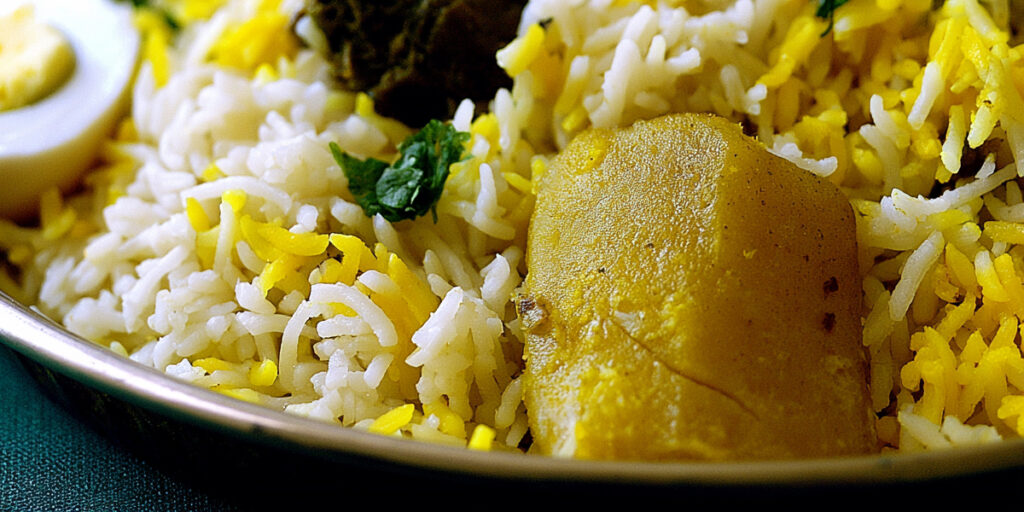
That potato is why this piece exists.
Because the Indus Plains has potato in its biryani too, for the same reason of economy, at the other end of the arc. Same vegetable, opposite jobs. At one end it is buried inside something loud, one more thing competing in a pot that is already arguing. At the other it sits at the quiet centre of a dish built on restraint, whole and golden and impossible to miss.
One ingredient. Two entirely different kitchens reaching for it. You cannot see that in an alphabetical index of recipes, and you cannot see it in a list of countries. You can only see it on a map.
Read them side by side
- Sindhi Biryani — the Indus Plains
- Lucknawi Mutton Biryani — the Mughal Corridor
- Bengali Mutton Biryani — the River Delta
From the map
Three others worth your evening:
- Dal Pakwan — the Indus Plains. Chana dal simmered to the point of just breaking, eaten with crisp unleavened fried bread and three chutneys. The Sindhi breakfast that defines a community.
- Sheermal — the Mughal Corridor. Saffron-milk flatbread from the by-lanes of Lucknow — the name is Persian, sheer for milk, mal to knead. Eaten with nihari at dawn or kebabs at night.
- Kosha Mangsho — the River Delta. Mutton dry-fried without water until the fat renders and the spices blacken at the edges, leaving a coating rather than a gravy.
From the pantry
Kewra — the thing that survived the journey.
Kewra water is distilled from the male flowers of the screwpine, a coastal pandanus with long serrated leaves and a bloom that smells like nothing else in the pantry: floral, faintly musky, closer to a perfume than a food. Which is what it is. The distillers of Kannauj who make it have been making attar for the skin in the same stills for centuries.
It goes into the Lucknawi pot at the last moment, with rose water and a breath of ittar, and it is still going into the Bengali one — the one detail of that kitchen that made it through exile intact while the spice hand lightened and the meat gave way to potato. If you want to know what a court kitchen thought was worth keeping, this is the answer.
Use it the way both recipes tell you to. A few drops scent the pot. A spoonful ruins it.
Found by You
Every dish on the atlas comes from one specific, named source — a book with a year on it, a dated post, a person who cooks it. The Sindhi biryani above came from an Urdu-language food blog. The Bengali one came from a Kolkata cookbook printed in 1978.
Some of the best versions are not written down anywhere at all. They are in a household.
If your family cooks something we have not covered — or cooks something we have covered differently — tell us. We research and write every page ourselves, so we cannot promise a timeline, but every submission is read. If we take yours into production, you are credited by the name you choose.
Found & Feasted — the culinary atlas of the feasting world.