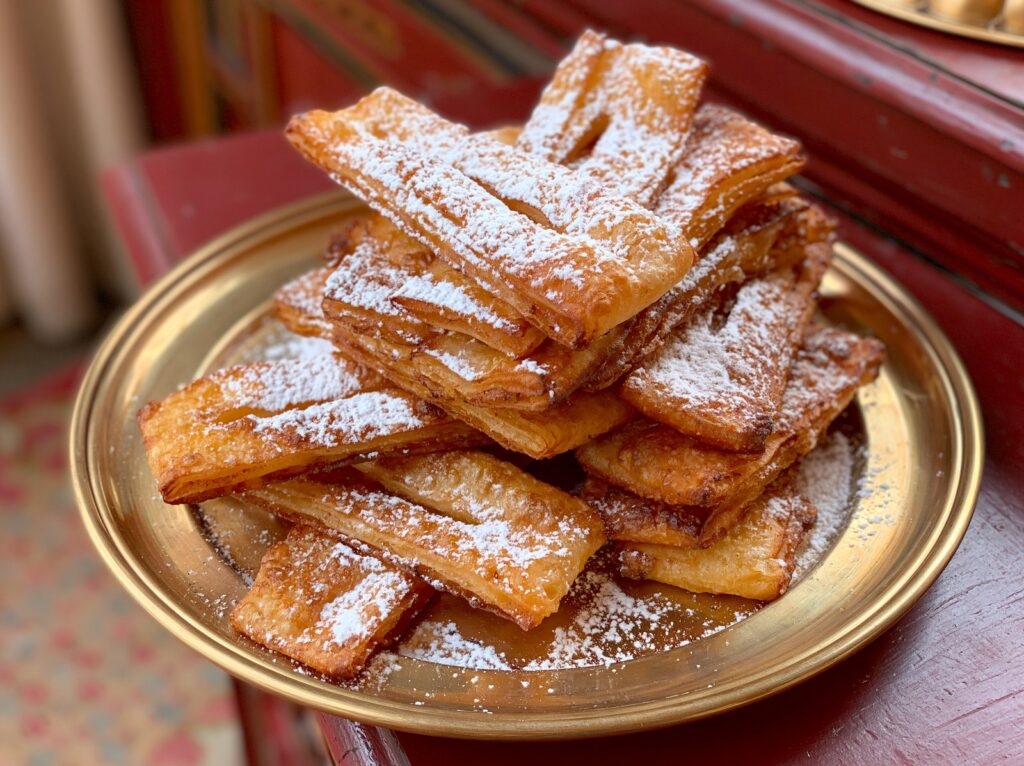
Khapse is what a Tibetan or Bhutanese house looks like at new year. Flour, butter, sugar and egg are worked into a firm dough, cut and twisted into shapes, and deep fried, and the shape carries the meaning. The giant bhungu amchoe, the donkey ear, is built for the Losar shrine rather than for eating. Mukdung are braids, bulug are crisp rings, kaptog are the small everyday shapes people actually pick up, and below those come nameless little diamonds of fried dough that exist purely to go with tea. They are barely sweet, which surprises everyone who expects a doughnut, and they are eaten with sweet milk tea or with suja, the salted butter tea. Households in Tibet, Bhutan, Sikkim and Darjeeling all make them, along with Tibetan families anywhere in the world, and the more elaborate shapes are a matter of real pride and long practice.
INGREDIENTS
- 400 g plain flour
- 100 g unsalted butter (softened)
- 60 g caster sugar
- 2 eggs
- 120 ml milk
- ¼ tsp salt
- 1 litre vegetable oil (for frying)
- icing sugar (to finish (optional))
METHOD
- Warm the milk slightly and stir the sugar into it until dissolved.
- Rub the butter into the flour and salt with your fingertips until it looks like coarse crumbs.
- Beat the eggs into the sweetened milk, pour into the flour and bring it together into a firm dough. Knead for 5 minutes until smooth, then cover and rest for 20 minutes.
- Roll out on a very lightly floured surface to about 5mm thick.
- Cut into strips roughly 3cm wide, then cut those on the diagonal into diamonds. For the twisted shape, cut rectangles, make a slit down the centre of each and pull one end back through the slit.
- Heat the oil in a deep heavy pan to 170C. Test it with one offcut: it should rise to the surface immediately and colour steadily rather than fiercely.
- Fry in small batches for 3 to 4 minutes, turning gently with a dry slotted spoon, until deep gold all over.
- Lift out and drain on a rack over paper. Dust with icing sugar if you like and cool completely before storing.