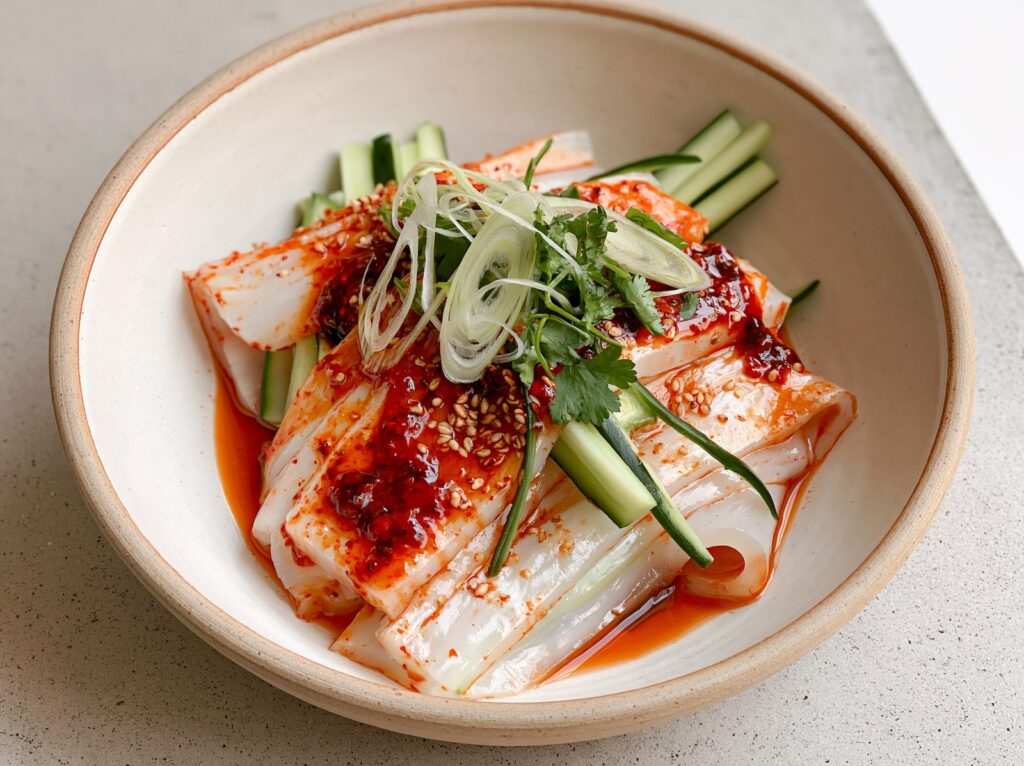
Laphing is a Lhasa street food and almost nobody in Lhasa makes it at home. You buy it from a stall: a slab of cold mung bean starch gel, sliced into wide slippery sheets, buried under chilli oil, garlic, soy and vinegar. The dish came over the border from Sichuan, where the same gel is called liangfen, meaning cold starch, and it settled into Tibetan hands with a sauce of its own. In Tibetan medicine both mung bean and cucumber are cooling, which is why this is a summer dish and why the cucumber on top is not a garnish. The gel itself is deliberately close to flavourless and exists to carry the sauce. Two versions are sold side by side, white from mung bean starch, firmer and glossier, and yellow from potato or wheat starch, softer and paler. It travelled with the exile community: you find it in Dharamsala, in Boudha in Kathmandu, and now in Tibetan kitchens in New York, Oxford and anywhere else with no stall to buy it from.
INGREDIENTS
- 130 g mung bean starch
- 700 ml cold water
- ½ tsp salt
- 4 tbsp chilli oil
- 3 tbsp light soy sauce
- 2 tbsp Chinkiang black vinegar
- 4 garlic cloves (crushed to a paste)
- 1 tsp ground Sichuan peppercorns
- 1 tbsp toasted sesame seeds
- ½ cucumber (cut into fine matchsticks)
- 3 spring onions (finely sliced)
- a handful of coriander (chopped)
- ½ tsp sugar
METHOD
- Whisk the mung bean starch into the cold water with the salt until completely smooth. Leave no granules, since they will not disperse once the heat is on.
- Pour into a saucepan and set over a medium heat. Stir constantly with a wooden spoon, scraping the base, for 5 to 7 minutes.
- The mixture will thicken suddenly, turn glossy and start pulling away from the sides in a single mass. Keep stirring for another minute once it does.
- Pour into a shallow oiled tray, smooth the top and leave to cool completely, then refrigerate for at least 4 hours or overnight until firm enough to slice cleanly.
- Make the sauce by mixing the chilli oil, soy, vinegar, garlic, ground peppercorns, sesame seeds and sugar. Taste it: it should be sharper and saltier than seems reasonable on its own.
- Turn the set gel out and cut it into wide flat strips about the width of two fingers.
- Pile the strips into bowls, spoon the sauce over generously, and top with the cucumber, spring onions and coriander. Serve cold.