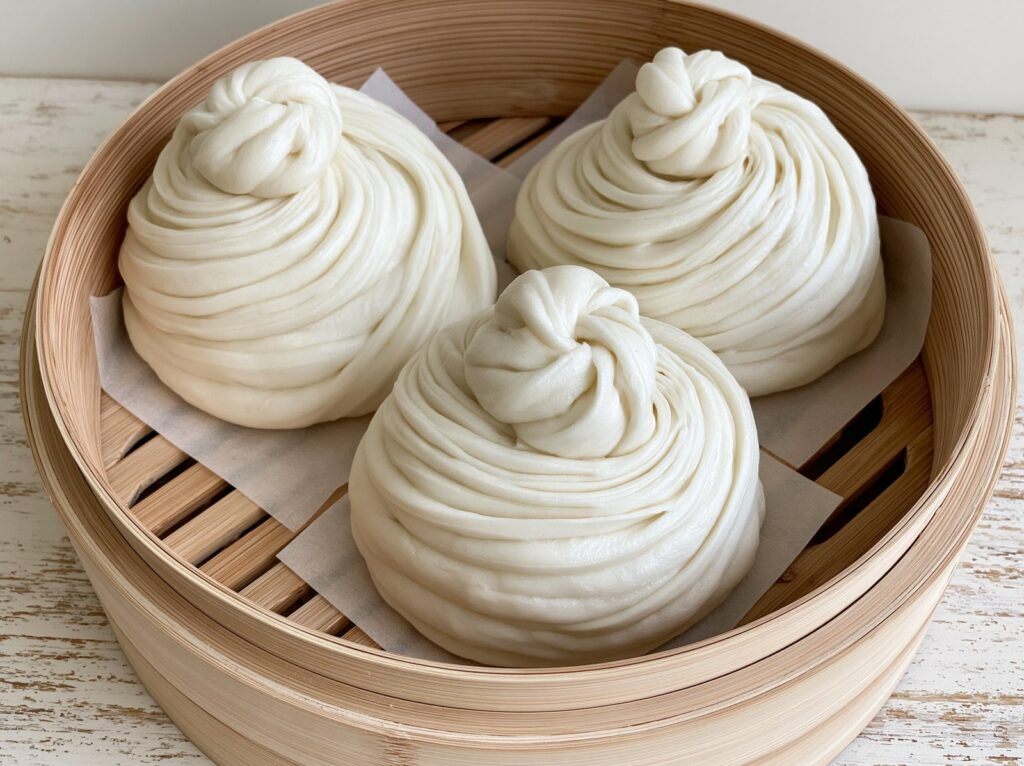
Tingmo is a cloud dumpling, or that is what the name is usually taken to mean: tinga for cloud and momo for dumpling. It is a yeasted wheat dough rolled thin, folded into layers, twisted and steamed until it opens out like something between a flower and a fist, and it is deliberately plain. There is nothing inside it, because the moment you put something inside it stops being tingmo and becomes a momo. Its job is to be torn apart and pushed through whatever else is on the table, a chilli potato, a stew, a bowl of shaptak, and to carry the sauce. Anything left over gets halved and fried in a pan the next morning, which is a better breakfast than the fresh version, and eaten with sweet milk tea.
Zone: Tibetan Sphere
INGREDIENTS
- 400 g plain flour
- 1.5 tsp instant yeast
- 1 tsp sugar
- ½ tsp salt
- 240 ml warm water
- 1 tbsp vegetable oil (plus more for brushing)
METHOD
- Mix the flour, yeast, sugar and salt in a bowl. Add the water and oil and bring together into a dough.
- Knead for 10 minutes until smooth and elastic, then cover and leave in a warm place for an hour, until doubled.
- Knock the dough back and divide it in two. Keep one half covered.
- Roll the first piece into a rectangle about 3mm thick. Brush it lightly with oil.
- Fold the left quarter in and the right quarter in so the edges meet in the middle, then fold one side over the other to give a narrow strip four layers thick.
- Turn it ninety degrees and cut into six equal pieces. Stack them in pairs, giving three buns of eight layers each.
- Press a chopstick down firmly through the centre of each bun so the layers splay out at the sides, then lift it out.
- Pick the bun up by both ends, stretch it gently to about a third longer, twist it twice, and tuck the ends underneath, pressing to seal.
- Repeat with the second piece of dough. Set the buns on squares of baking paper in a steamer, cover, and leave to proof for 30 minutes.
- Steam over simmering water for 20 to 25 minutes, without lifting the lid, until firm and springy. Serve hot.
NOTES
UK adaptation: Plain flour rather than strong bread flour, since tingmo wants softness rather than chew. Use instant yeast and give the shaped buns a proper second proof in the steamer before the heat goes on, which is the step most often skipped. Line the steamer with paper squares, as the dough sticks hard to bamboo and metal alike. Coloured versions made with beetroot or spinach are modern and common, and no less authentic for it. Everything else widely available.
US adaptation: All-purpose flour rather than bread flour. Instant yeast, and proof the shaped buns in the steamer before turning on the heat. Line the steamer with parchment squares. Everything else widely available.
Cook’s note: Proof the shaped buns a second time, in the steamer, for a full half hour before any heat reaches them. Skipping it is why home tingmo comes out dense and closed instead of opening into layers. Once the steam is going, leave the lid alone: lifting it drops the temperature and the buns collapse.