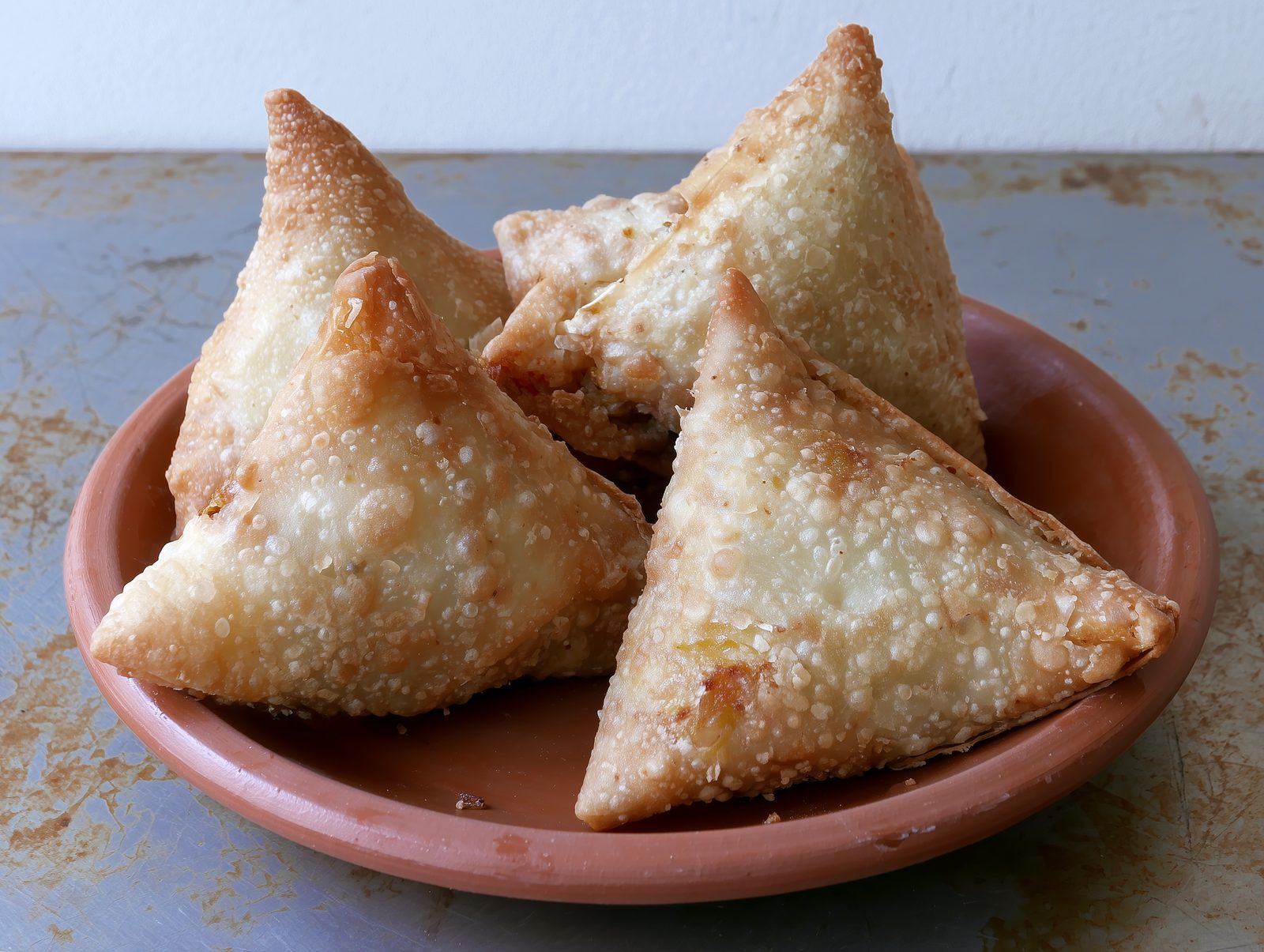
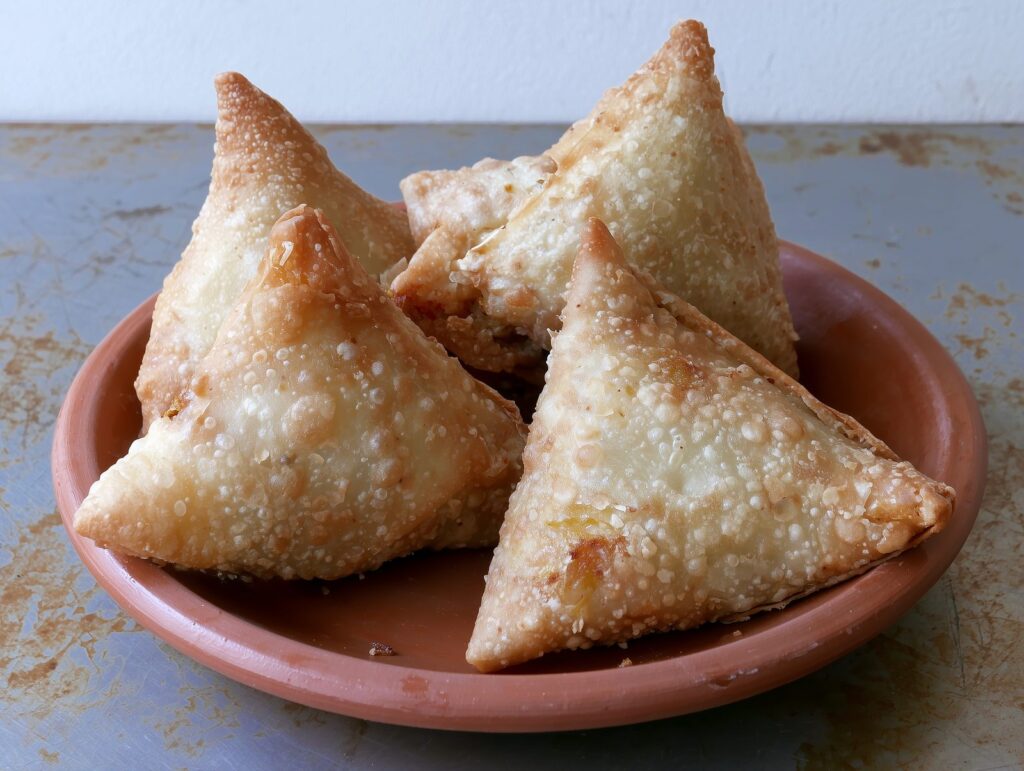
The Sindhi samosa is recognisable first by its casing — thinner, more brittle, shattering rather than bending when you bite it — and second by the filling, in which asafoetida takes the dominant aromatic position that onion would hold in most other regional versions. Where a Punjabi samosa is warm and mild, the Sindhi one is sharp and pungent, the hing making its presence clearly known in every mouthful alongside the amchur sourness that appears throughout Sindhi snack cooking. It is the zone’s fingerprint on a dish that the entire subcontinent makes its own, placed in its zone by the spice that defines the zone.
Zone: Indus Plains
SOURCE: Sindhi halwai, Karachi, recipe shared on Urdu food platform, 2021
LOCAL NAME: سندھی سموسہ
INGREDIENTS
- For the casing: 2 cups plain flour
- ½ tsp ajwain (carom seeds)
- ½ tsp salt
- 3 tbsp neutral oil
- cold water to knead (add sparingly)
- For the filling: 4 medium potatoes (boiled and roughly mashed)
- ¼ tsp asafoetida (hing)
- 1 tsp cumin seeds
- 1 tsp coriander seeds (coarsely crushed)
- 1 tsp amchur (dry mango powder)
- ½ tsp red chilli powder
- 1 tsp salt
- 1 tbsp neutral oil
- chopped coriander
- neutral oil for deep-frying
METHOD
- Make the casing dough: mix flour, ajwain and salt. Rub in the oil until it resembles fine crumbs. Add cold water very sparingly — just enough to form a very stiff, firm dough. Knead 8 minutes until smooth. Cover and rest 20 minutes.
- For the filling: heat 1 tbsp oil in a pan. Add the asafoetida, cumin and coriander seeds; sizzle 20 seconds. Add the mashed potato, amchur, red chilli and salt. Mix well and cook until dry, 3–4 minutes. Stir in coriander. Cool completely.
- Divide the dough into 8 portions. Roll each into a thin oval (about 2–3mm). Cut in half. Fold each half into a cone, sealing the edge with a little water. Fill with the potato mixture. Seal the open edge firmly.
- Heat oil to 160°C. Fry the samosas slowly for 8–10 minutes until evenly golden and completely crisp throughout. The slow fry is what creates the distinctive brittle casing.
- Serve with tamarind and green chutneys.
NOTES
UK adaptation: Plain flour or a mix of flour and semolina for the casing. Amchur and asafoetida from any South Asian grocer. Everything else widely available.
US adaptation: All-purpose flour for the casing. Amchur and asafoetida from Patel Brothers or Indian grocery stores. Everything else widely available.
Cook’s note: The casing must be made from a stiff, dry dough — not soft. Soft dough produces a chewy samosa; stiff dough produces the brittle, shattering crust that makes a Sindhi samosa what it is.
Cook this differently? Share your family’s version — or tell us what we’re missing.
Contribute