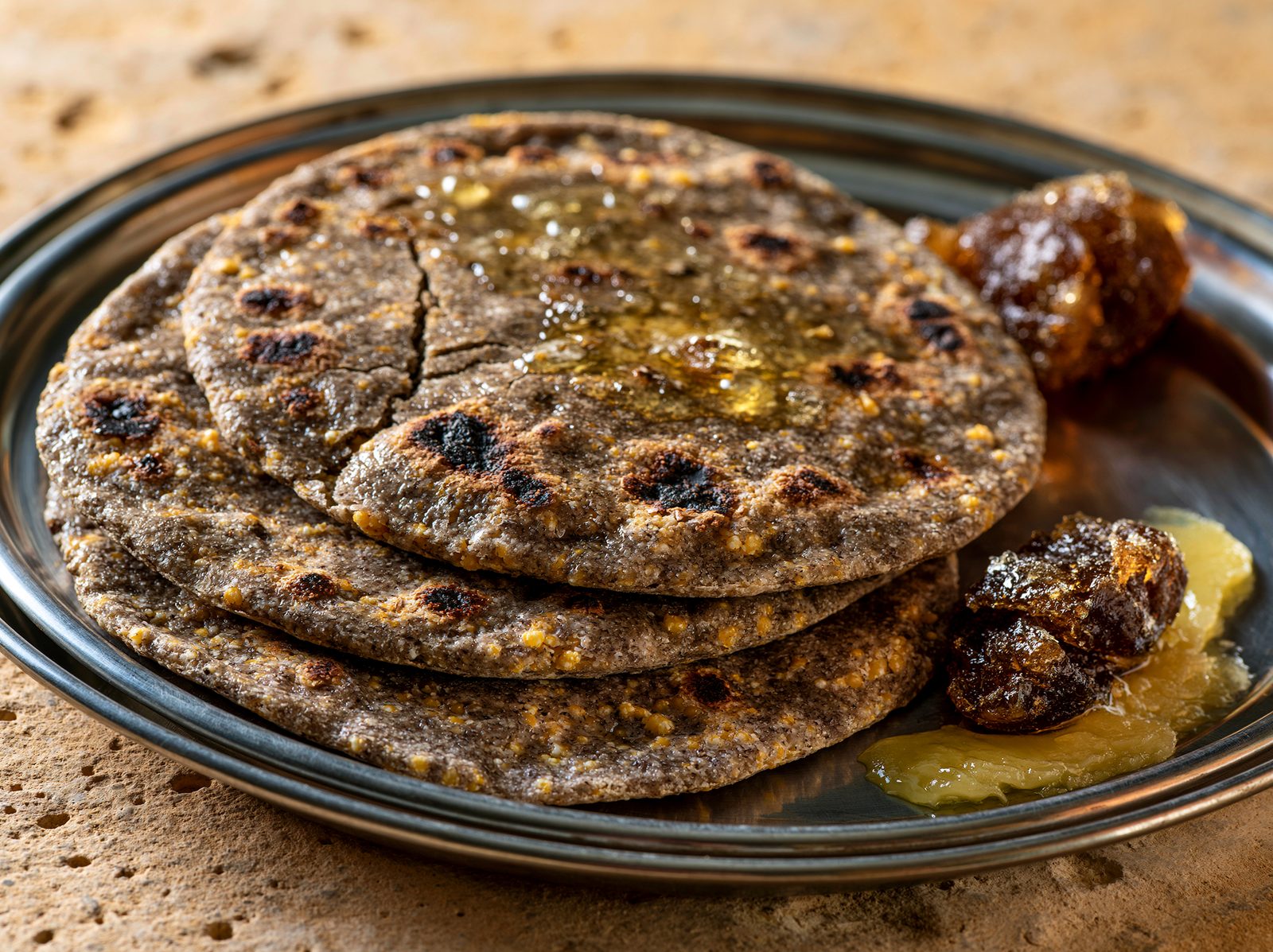
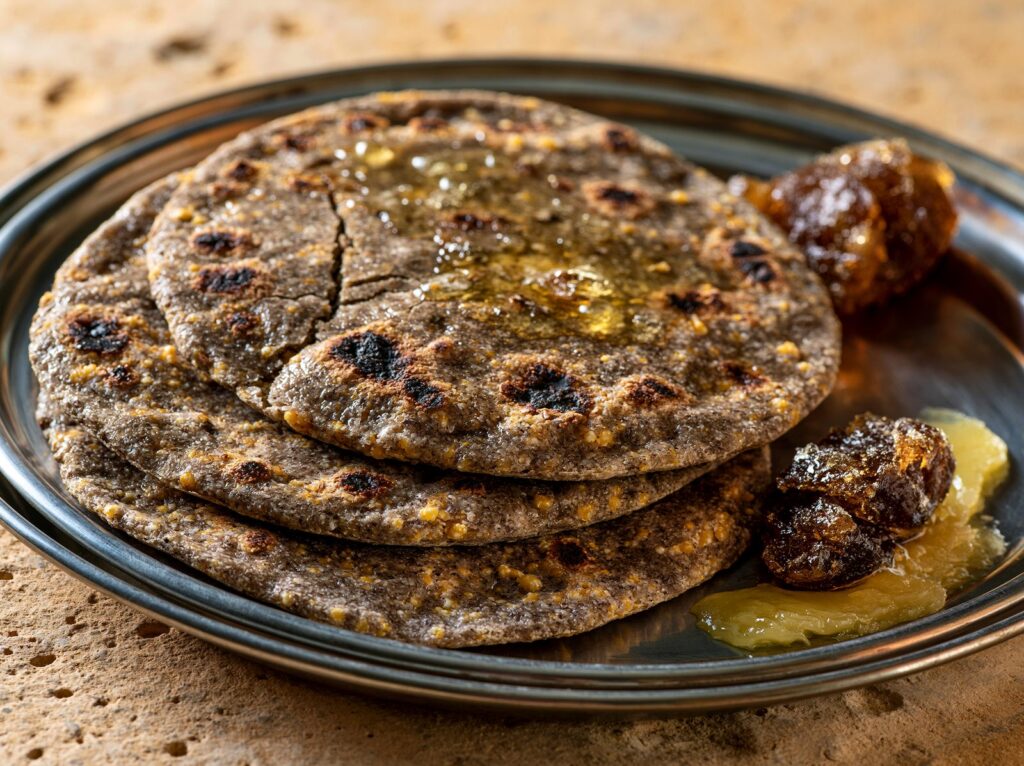
Bajri jo Roto — millet flatbread — is the food that predates the wheat tradition across the arid western reaches of Sindh. Pearl millet (bajri) is the grain of the desert margin, drought-tolerant and ancient, and its flatbread is thicker, rougher, and more intensely flavoured than any wheat roti. The Dadu and Tharparkar districts still eat it daily; the Karachi diaspora eats it on certain mornings to remember where they come from. It is made without water — only freshly milled bajri flour and a knob of ghee — and eaten with jaggery and fresh ghee, or alongside a bowl of Sindhi kadhi when the day calls for both substance and sourness. It is the oldest breakfast in the zone.
Zone: Indus Plains
SOURCE: Rural Sindhi household, Dadu district, oral recipe, 2021
LOCAL NAME: باجری جو روٹو
INGREDIENTS
- 2 cups pearl millet flour (bajri atta)
- ½ tsp salt
- 1 tbsp ghee (plus more for serving)
- warm water (added sparingly, to bring together)
- jaggery (gur to serve)
METHOD
- Mix the bajri flour with the salt. Rub in the ghee until evenly distributed.
- Add warm water a tablespoon at a time — 4–6 tbsp in total — until the dough just comes together. It will be crumbly and soft, not smooth like wheat dough. Do not over-knead.
- Divide into 4 portions. Place each portion on a piece of damp cloth or between two sheets of cling film and press out to a disc about 1cm thick by hand — bajri dough is too fragile to roll with a pin. Transfer to the tawa by flipping the cloth.
- Cook on a medium tawa for 5–6 minutes on the first side until the surface dries and small cracks appear. Flip carefully.
- Cook the second side for 4–5 minutes until lightly charred in spots. Place directly over a low flame for 1–2 minutes to dry through completely.
- Smear with ghee and serve hot with a piece of jaggery on the side, or alongside Sindhi kadhi.
NOTES
UK adaptation: Pearl millet flour (bajri atta) from South Asian grocers and some health food stores (also sold as ‘finger millet’ or ‘millet flour’). It has a short shelf life once milled — buy small quantities. Everything else widely available.
US adaptation: Bajri atta (pearl millet flour) from Indian grocery stores or health food stores. Do not substitute with corn flour or other grain flours — the flavour and texture are specific to pearl millet. Everything else widely available.
Cook’s note: Millet dough is fragile and does not gluten-bind like wheat. Handle it gently, keep it thick (about 1cm), and cook it on the lower side of medium heat so it dries through without cracking.
Cook this differently? Share your family’s version — or tell us what we’re missing.
Contribute