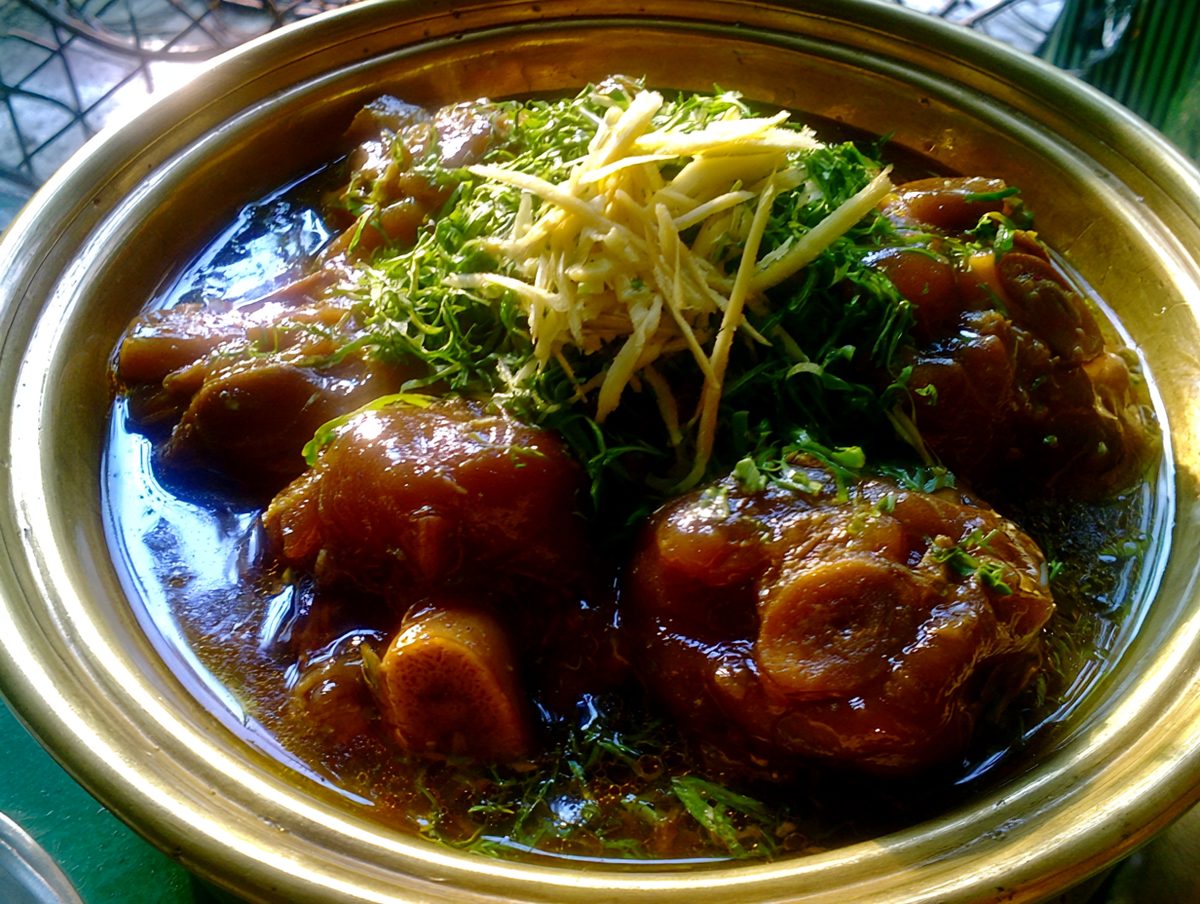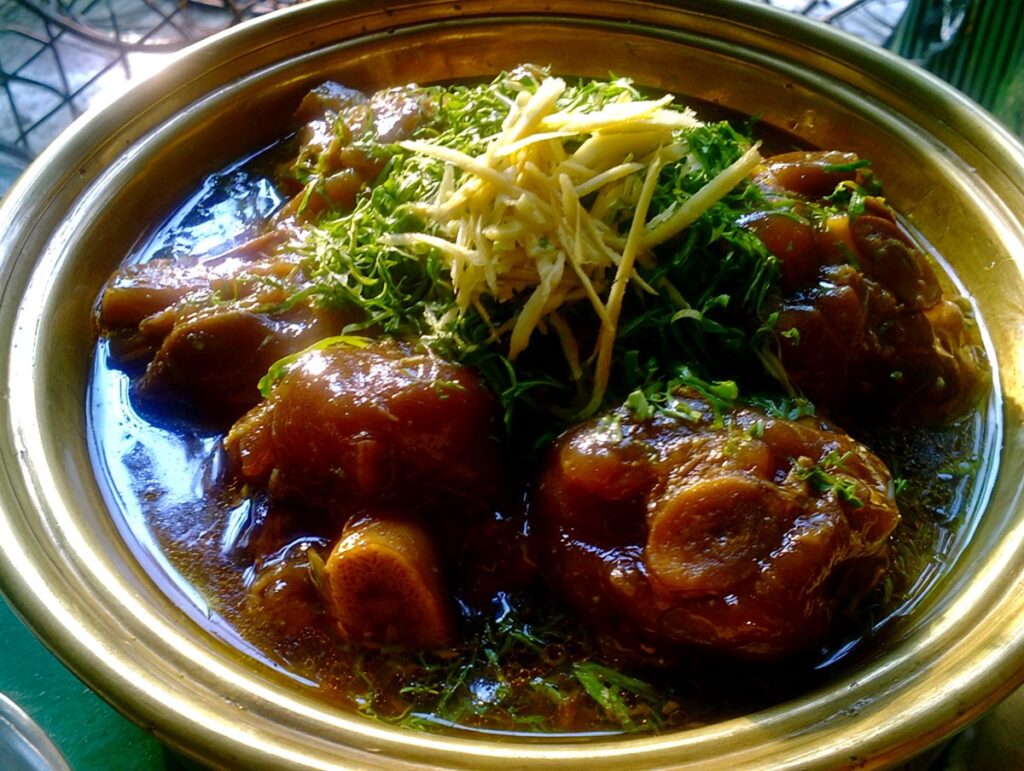
Paya means feet — the trotters of goat, lamb or cow — and the dish is the great act of thrift in Mughal nose-to-tail cooking: the parts the grand kitchens once threw out, simmered overnight until the collagen in the bones melts into a thin, glassy broth. In the Mughal Corridor its home is Lahore, where siri paye is the dawn breakfast, ladled out before sunrise from cauldrons that have bubbled all night and eaten with hot naan or kulcha — the Lahori institution Phajja Siri Paye built its name on exactly these once-humble trotters. It is a cousin of nihari but should never be confused with it: where nihari is thickened to a glossy gravy, paye is kept deliberately thin and soupy, lightly spiced so the broth itself does the talking, finished at the bowl with slivered ginger, green chilli, coriander and lemon. Cooks often add bong, the shank, for some meat to chew alongside the silken trotters. This version follows It’s Tasty by Gohar, whose Lahori bong paya sets down the street-style method — an English-language record of a dish Lahore wakes up for.
INGREDIENTS
- 8 pieces goat or lamb trotters (paye, cleaned)
- 1 piece bong (beef or lamb shank, optional, for meat)
- 3 large onions (finely sliced)
- 2 tbsp ginger-garlic paste
- 4 tbsp ghee
- 3 tbsp neutral oil
- 2 tbsp nihari or paya masala
- 1 tsp Kashmiri red chilli powder
- 1 tsp turmeric
- 1 tbsp coriander seeds
- 1 black cardamom pod
- 4 cloves
- 1 cinnamon stick
- 1½ tsp salt (plus more to taste)
- 2.5 litres water
- 2 inches ginger (julienned, to finish)
- 2 green chillies (slit, to finish)
- chopped coriander and lemon wedges (to serve)
METHOD
- Scrub the trotters well and singe off any hair over a flame, then rinse; soak in salted water for an hour and drain.
- Warm the ghee and oil in a large heavy pot and fry the onions until deep golden, 12–15 minutes.
- Add the ginger-garlic paste, then the trotters (and shank, if using), and fry for 5 minutes.
- Stir in the paya masala, Kashmiri chilli, turmeric, coriander seeds, black cardamom, cloves, cinnamon and salt, and fry for 2–3 minutes.
- Pour in the water, bring to a boil, skim off the foam, then lower to the gentlest simmer, cover, and cook for 4–5 hours (or pressure-cook 1–1.5 hours) until the trotters are sticky-soft and the broth is gelatinous.
- Keep the broth thin and soupy — top up with hot water rather than letting it reduce to a thick gravy.
- Check the salt and rest off the heat for a few minutes.
- Serve in bowls with julienned ginger, green chilli and coriander, lemon to squeeze over, and hot naan or kulcha.