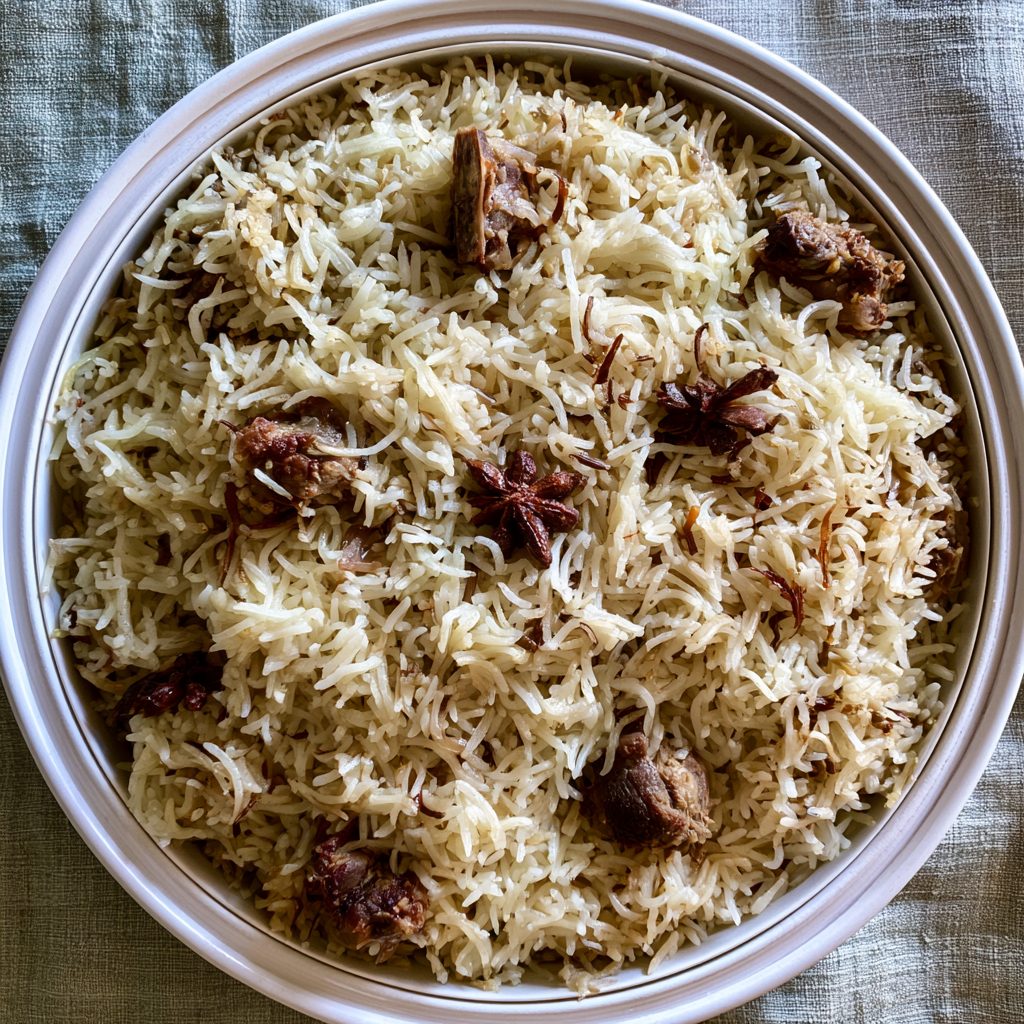
Yakhni is the Persian word for a meat broth, and yakhni pulao is the dish built on it: bone-in mutton slow-boiled with whole spices, onion, ginger and garlic until the bones give up a clear, deep stock, which then becomes the only liquid the rice is cooked in. It travelled the routes the conquerors did — out of Persia, through Central Asia and the Kashmiri wazas, into the Mughal kitchen — and in the corridor it settled as the celebratory rice of Awadh and Delhi, the pulao of Eid and weddings, and a particular speciality of the Kayasthas of old Delhi. It is not a biryani: nothing is layered, the rice is never par-boiled and drained but cooked through in the stock, one pot, and the result is subtle and savoury rather than perfumed and fiery — the strict Awadhi version doesn’t even take green chilli. The whole thing rests on the yakhni, so the stock is made with patience and bone. This version follows Farrukh Aziz, whose Cubes N Juliennes sets down the Lucknawi mutton yakhni pulao — an English-language record of a nawabi one-pot.
INGREDIENTS
- 700 g bone-in mutton or goat (cut into pieces)
- 400 g aged basmati rice
- 2 large onions (1 quartered for the stock, 1 sliced for birista)
- 2 tbsp ginger-garlic paste
- 1 tbsp fennel seeds
- 1 tsp cumin seeds
- 1 tbsp coriander seeds
- 2 black cardamom pods
- 4 green cardamom pods
- 6 cloves
- 1 cinnamon stick
- 8 black peppercorns
- 1 tsp mace blades
- 2 bay leaves
- 4 tbsp ghee
- 2 tbsp neutral oil
- 3 tbsp plain yogurt (whisked)
- 1½ tsp salt (plus more to taste)
- 1 tbsp kewra water
- chopped coriander (to serve)
METHOD
- Tie the fennel, cumin and coriander seeds, both cardamoms, cloves, cinnamon, peppercorns, mace and bay leaves loosely in a muslin pouch.
- Put the meat, the quartered onion, half the ginger-garlic paste, the spice pouch, 1 tsp salt and about 1.5 litres water in a pot, bring to a boil, skim, then cover and simmer until the meat is tender, 60–75 minutes.
- Lift out the meat, squeeze and remove the spice pouch, and strain the yakhni; measure it and top up to about 1.5 times the volume of the soaked rice if needed.
- Soak the rice 30 minutes and drain; fry the sliced onion in the ghee and oil until golden, lifting out half as birista.
- To the pan add the remaining ginger-garlic paste and the cooked meat with the yogurt, and fry for 2–3 minutes.
- Add the drained rice and toss gently for a minute, then pour in the measured hot yakhni and the kewra water and bring to a boil.
- Once most of the stock is absorbed and the surface is dimpling, cover tightly, lower to the gentlest heat, and cook on dum for 12–15 minutes.
- Rest 10 minutes, fork through gently, and serve scattered with the birista and coriander, with a raita alongside.