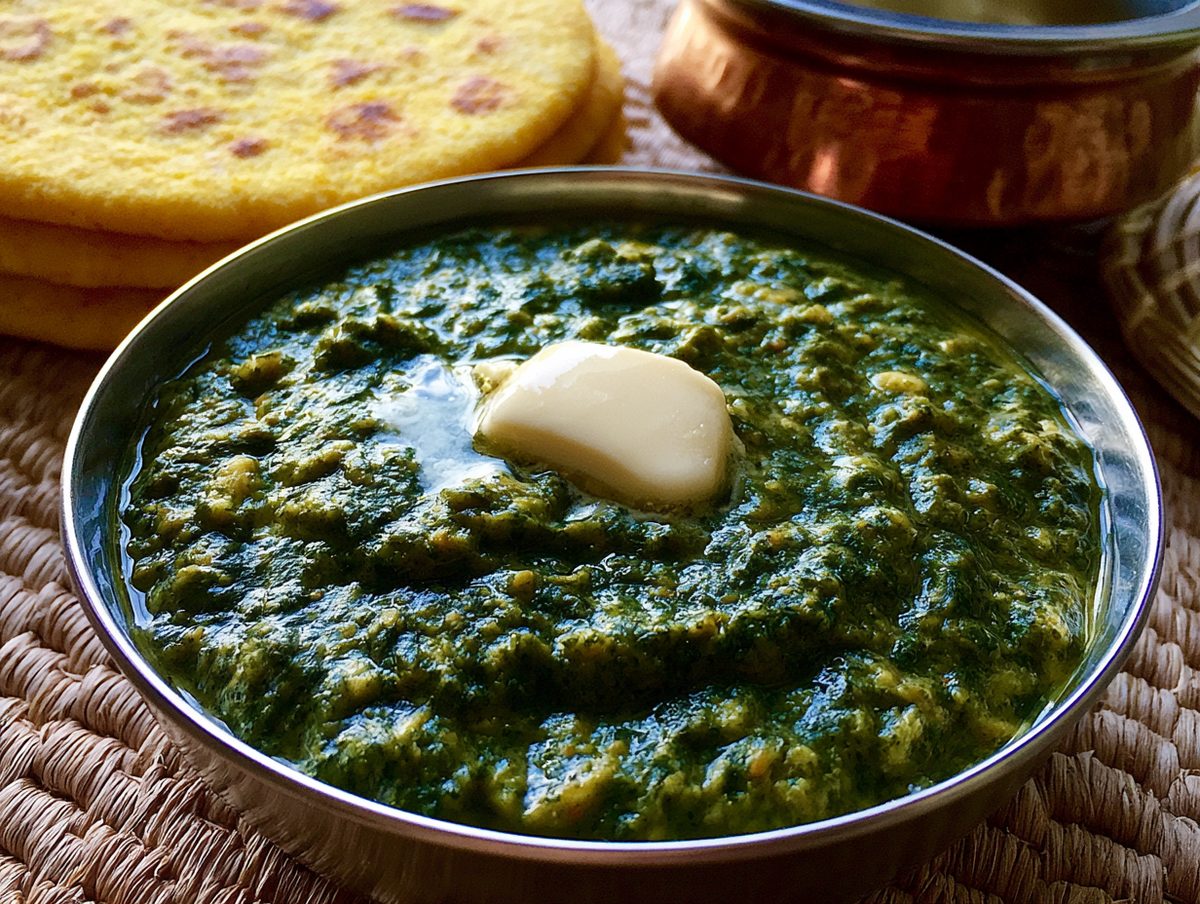
In the Punjab countryside sarson ka saag is the dish that announces winter: when the mustard fields flower yellow and the cold sets in, households cook down mustard greens with a little spinach and bathua until the bitterness softens into something deep and almost sweet. It is the centrepiece of Lohri, the January harvest fire-festival, ladled out with makki di roti — flatbread of maize, a grain that only reached Punjab some four hundred years ago and has been wedded to the saag ever since — with a knob of white butter melting on top, raw onion and a lump of gur on the side. The greens are not blended smooth but simmered slow and mashed by hand, then bound with a spoon of maize flour and woken up with a ghee-and-garlic tadka; it is patience more than technique. This version follows the food writer Meeta Arora, who recorded her mother’s Punjabi saag — the one she makes for Lohri — on her site Piping Pot Curry, an English-language account of the kind of seasonal home cooking that rarely leaves the family.
INGREDIENTS
- 500 g mustard greens (sarson, stems removed, roughly chopped)
- 200 g spinach (palak, roughly chopped)
- 100 g bathua leaves (chopped (optional))
- 1 small turnip or radish (chopped (optional))
- 1 inch ginger (roughly chopped)
- 8 garlic cloves (4 for the greens, 4 for the tadka)
- 2 green chillies
- 1½ tsp salt (plus more to taste)
- 2 tbsp makki ka atta (fine maize flour, plus 4 tbsp water)
- 3 tbsp ghee
- 1 small onion (finely chopped)
- 1 dried red chilli
- ½ tsp Kashmiri red chilli powder
- white butter (safed makhan, to finish)
- jaggery (gur and sliced onion, to serve)
METHOD
- Put the mustard greens, spinach, bathua, turnip, ginger, 4 of the garlic cloves, the green chillies and 1 tsp salt in a heavy pot with 250ml water.
- Cover and simmer on low until everything is completely soft, 35–40 minutes, adding a splash of water if it dries out.
- Mash the greens by hand with a wooden masher (mathani), or pulse very briefly — keep some texture rather than blending to a smooth purée.
- Stir the maize flour into the 4 tbsp water to a smooth slurry, pour it into the saag, and simmer on low for 20–25 minutes, stirring often, until thick and glossy.
- For the tadka, warm the ghee and fry the remaining chopped garlic and the onion until golden, then take off the heat and add the dried red chilli and Kashmiri chilli powder.
- Pour most of the tadka into the saag, stir through, and adjust the salt.
- Serve hot with the rest of the tadka spooned over, a knob of white butter melting on top, and gur and sliced onion alongside makki di roti.